The commodity channel index (CCI)is an oscillator originally introduced by Donald Lambert in 1980.
Since its introduction, the indicator has grown in popularity and is now a very common tool for traders in identifying cyclical trends not only in commodities but also equities and currencies. The CCI can be adjusted to the timeframe of the market traded on by changing the averaging period.
1. Calculation
CCI measures a security’s variation from the statistical mean.
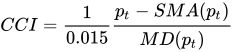
The Commodity Channel Index (CCI)indicator is calculated as the difference between the typical price of a commodity and its simple moving average, divided by the mean absolute deviation of the typical price. The index is usually scaled by an inverse factor of 0.015 to provide more readable numbers:
,
where pt is the , SMA is the simple moving average, and MD is the mean absolute deviation.
For scaling purposes, Lambert set the constant at 0.015 to ensure that approximately 70 to 80 percent of CCI values would fall between −100 and +100. The CCI fluctuates above and below zero. The percentage of CCI values that fall between +100 and −100 will depend on the number of periods used. A shorter CCI indicator will be more volatile with a smaller percentage of values between +100 and −100. Conversely, the more periods used to calculate the CCI, the higher the percentage of values between +100 and −100.
2. Use CCI Indicator
Traders and investors use the commodity channel index to help identify price reversals, price extremes and trend strength. As with most indicators, the CCI should be used in conjunction with other aspects of technical analysis. CCI fits into the momentum category of oscillators. In addition to momentum, volume indicators and the price chart may also influence a technical assessment. It is often used for detecting divergences from price trends as an overbought/oversold indicator, and to draw patterns on it and trade according to those patterns. In this respect, it is similar to bollinger bands, but is presented as an indicator rather than as overbought/oversold levels.
The CCI indicator typically oscillates above and below a zero line. Normal oscillations will occur within the range of +100 and −100. Readings above +100 imply an overbought condition, while readings below −100 imply an oversold condition. As with other overbought/oversold indicators, this means that there is a large probability that the price will correct to more representative levels.
The CCI has seen substantial growth in popularity amongst technical investors; today's traders often use the indicator to determine cyclical trends in not only commodities, but also equities and currencies.
The CCI, when used in conjunction with other oscillators, can be a valuable tool to identify potential peaks and valleys in the asset's price, and thus provide investors with reasonable evidence to estimate changes in the direction of price movement of the asset.
Lambert's trading guidelines for the CCI focused on movements above +100 and below −100 to generate buy and sell signals. Because about 70 to 80 percent of the CCI values are between +100 and −100, a buy or sell signal will be in force only 20 to 30 percent of the time. When the CCI moves above +100, a security is considered to be entering into a strong uptrend and a buy signal is given. The position should be closed when the CCI moves back below +100. When the CCI moves below −100, the security is considered to be in a strong downtrend and a sell signal is given. The position should be closed when the CCI moves back above −100.
Since Lambert's original guidelines, traders have also found the CCI valuable for identifying reversals. The CCI is a versatile indicator capable of producing a wide array of buy and sell signals.
Commodity Channel Index CCI can be used to identify overbought and oversold levels. A security would be deemed oversold when the CCI dips below −100 and overbought when it exceeds +100. From oversold levels, a buy signal might be given when the CCI moves back above −100. From overbought levels, a sell signal might be given when the CCI moved back below +100.
As with most oscillators, divergences can also be applied to increase the robustness of signals. A positive divergence below −100 would increase the robustness of a signal based on a move back above −100. A negative divergence above +100 would increase the robustness of a signal based on a move back below +100.
Trend line breaks can be used to generate signals. Trend lines can be drawn connecting the peaks and troughs. From oversold levels, an advance above −100 and trend line breakout could be considered bullish. From overbought levels, a decline below +100 and a trend line break could be considered bearish.
3. KEY TAKEAWAYS
+ The CCI is a market indicator used to track market movements that may indicate buying or selling.
+ The CCI compares current price to average price over a specific time period.
+ Different strategies can use the CCI in different ways, including using it across multiple timeframes to establish dominant trends, pullbacks, or entry points into that trend.
+ Some trading strategies based on CCI Indicator can produce multiple false signals or losing trades when conditions turn choppy.
Technical analysis (TA) is, essentially, the practice of examining previous market events as a way to try and predict future trends and price action. From traditional to cryptocurrency markets, most traders rely on specialized tools to perform these analyses, and the RSI is one of them.
The Relative Strength Index (RSI) is a TA indicator developed in the late 1970s as a tool that traders could use to examine how a stock is performing over a certain period. It is, basically, a momentum oscillator that measures the magnitude of price movements as well as the speed (velocity) of these movements. The RSI can be a very helpful tool depending on the trader profile and their trading setup.
The Relative Strength Index indicator was created by J. Welles Wilder in 1978. It was presented in his book New Concepts in Technical Trading Systems, along with other TA indicators, such as the Parabolic SAR, the Average True Range (ATR), and the Average Directional Index (ADX).
Before becoming a technical analyst, Wilder worked as a mechanical engineer and real estate developer. He started trading stocks around 1972 but wasn't very successful. A few years later, Wilder compiled his trading research and experience into mathematical formulas and indicators that were later adopted by many traders around the world. The book was produced in only six months, and despite dating back to the 1970s, it is still a reference to many chartists and traders today.
2. How does the RSI indicator work?
By default, the RSI measures the changes in an asset's price over 14 periods (14 days on daily charts, 14 hours on hourly charts, and so on). The formula divides the average gain the price has had over that time by the average loss it has sustained and then plots data on a scale from 0 to 100.
As mentioned, the RSI is a momentum indicator, which is a type of technical trading tool that measures the rate at which the price (or data) is changing. When momentum increases and the price is rising, it indicates that the stock is being actively bought in the market. If momentum increases to the downside, it is a sign that the selling pressure is increasing.
The RSI is also an oscillating indicator that makes it easier for traders to spot overbought or oversold market conditions. It evaluates the asset price on a scale of 0 to 100, considering the 14 periods. While an RSI score of 30 or less suggests that the asset is probably close to its bottom (oversold), a measurement above 70 indicates that the asset price is probably near its high (overbought) for that period.
Although the default settings for RSI is 14 periods, traders may choose to modify it in order to increase sensitivity (fewer periods) or decrease sensitivity (more periods). Therefore, a 7-day RSI is more sensitive to price movements than one that considers 21 days. Moreover, short-term trading setups may adjust the RSI indicator to consider 20 and 80 as oversold and overbought levels (instead of 30 and 70), so it is less likely to provide false signals.
3. How to use RSI based on divergences
Besides the RSI scores of 30 and 70 - which may suggest potentially oversold and overbought market conditions - traders also make use of the RSI to try and predict trend reversals or to spot support and resistance levels. Such an approach is based on the so-called bullish and bearish divergences.
A bullish divergence is a condition where the price and the RSI scores move in opposite directions. So, the RSI score rises and creates higher lows while the price falls, creating lower lows. This is called a "bullish" divergence and indicates that the buying force is getting stronger despite the price downtrend.
In contrast, bearish divergences may indicate that despite a rise in price, the market is losing momentum. Therefore, the RSI score drops and creates lower highs while the asset price increases and creates higher highs.
Keep in mind, however, that RSI divergences are not that reliable during strong market trends. This means that a strong downtrend may present many bullish divergences before the actual bottom is finally reached. Because of that, RSI divergences are better suited for less volatile markets (with sideways movements or subtle trends).
You have use tool filter coin with value of RSI (4h, 12h, 1day, 1week) :
Closing thoughts
There are several important factors to consider when using the Relative Strength Index indicator, such as the settings, the score (30 and 70), and the bullish/bearish divergences. However, one should always keep in mind that no technical indicator is 100% efficient - especially if it is used alone. Therefore, traders should consider using the RSI indicator along with other indicators in order to avoid false signals
Đối với con gái, việc đạt khoái cảm trong quan hệ tình dục là một trải nghiệm tuyệt hảo chưa hẳn ai cũng nhận được. Thế tuy nhiên, sẽ ra sao nếu các bạn đạt "cực khoái" lên đến 90 lần trong một giờ? Nghe có vẻ kích thích tuy nhiên thực chất với người đã trải qua cảm giác này thì nó kinh hoàng nhiều hơn nữa là vui sướng.
Cara Anaya-Carlis, 30 tuổi, tới từ Hoa Kỳ mắc 1 căn bệnh hiếm gặp mang tên “rối loạn khuấy động sinh dục dai dẳng” (Persistent Genital Arousal Disorder). Căn bệnh này khiến Cara liên tục trong tình trạng lên đỉnh không khống chế, đôi khi đến 90 lần/1 giờ.
Cara mắc căn bệnh lạ, cô liên tiếp lên đỉnh dù không muốn.
Cara chia sẻ, cách đó 4 năm cô mới bắt đầu phát bệnh trong 1 lần đi cửa hàng mua đồ. Trong lúc đang xem đồ, cô cảm thấy thân thể bỗng hưng phấn cao độ trước bất cứ thứ gì mình ngắm thấy, ngửi thấy hoặc chạm vào. Cô bắt đầu hoảng sợ, tuy nhiên cảm giác kích thích vẫn tiếp diễn không ngừng cho đến khi cô té lăn ra đất & "lên đỉnh" nhiều đợt liên tiếp ngay tại sàn nhà.
Âm thầm chịu đựng tình trạng như thế trong nhiều tháng cho đến 24h cô đành phải tìm đến cầu xin sự trợ giúp từ Bác Sỹ chuyên khoa. Rất tiếc Bác Sỹ cũng "bó tay" trước tình huống này.
Chứng bệnh khiến Cara không dám ra khỏi nhà.
Sau khi Bác Sỹ tư vấn cô hiểu ra đấy là chứng bệnh hiện vô phương cứu chữa, có thể sẽ phải sống chung với nó cả đời. Bác sĩ khuyên cô nên giảm thiểu tiếp xúc với đồ vật xung quanh gồm có cả: ngửi, ăn, nghe,... vì có thể là nhân tố gây ra cực khoái bất kể khi nào.
Kể từ sau lần đó, Cara gần như phải sống ẩn dật ở nhà & chẳng thể làm việc vì nhiều đợt "lên đỉnh" không ngừng dù đang ở siêu thị, trường học & thậm chí cả ở sân chơi công cộng. Cô đã test mọi phương pháp chữa bệnh căn bệnh lạ, kể cả dùng đá, tắm nước lạnh, đổi thay chính sách ăn & tăng chính sách tập luyện thể thao thể dục, tuy nhiên toàn bộ đều vô hiệu.
"Điều đó thật đáng xấu hổ. Ngay khi ở gần trẻ con, tôi cảm nhận thấy như 1 kẻ đồi trụy vì toàn bộ các cảm giác cực kì mạnh mẽ ấy chảy ào ạt khắp thân thể. Tôi vô cùng uể oải, đau đớn như bị tra tấn.
Căn bệnh này đã tàn phá quãng đời tôi, cả đàn ông tôi nữa. Tôi muốn cháu là 1 đứa trẻ thông thường. Nhưng cháu chẳng thể có các bạn bè vì tôi bị như vậy này. Điều tồi tệ đặc biệt là tôi chẳng thể lý giải cho con tôi vì cháu còn quá nhỏ”, Cara vô vọng.
Ngoài những nỗi khổ này, chứng bệnh lạ còn tạo áp lực nặng nề lên cuộc hôn nhân của Cara. Cô luôn thèm khát sự âu yếm, thân mật & đụng chạm thể xác trong lúc ông xã cô chỉ có nhu cầu hạn chế về số lần "yêu" nhất định.
Theo thời gian, Anaya-Carlis dần học được cách khống chế việc bộc lộ kích thích ra bên ngoài, thế tuy nhiên việc đó luôn khiến cô thấy uể oải về cả thể xác lẫn tinh thần. "Mỗi khi lên đỉnh ở nơi có người, tôi nén lại bằng phương pháp tự cười khúc khích. Bên ngoài, tôi trông thông thường, tuy nhiên bên trong đây là sự tra tấn. Chứng bệnh đang tàn phá đời sống & làm rối loạn đầu óc của tôi.”
Từ chối Hoàng tử Dubai, có bầu với trai trẻ, 19 năm sau thiếu nữ lên đỉnh cao thế giới
Giờ thì mười triệu con người ngưỡng mộ phải ghen tị với thiếu nữ này vì chọn lựa quá sáng suốt.
Bấm xem >>
Theo Lê Lê (Theo Sina) (thoidaiplus.giadinh.net.vn)